
How Germany Became an Export Power
Germany did not become an exporting nation overnight. Long before there was a German nation-state, merchants in northern ports, metalworkers in inland towns, and craft producers in regional hubs were already learning how to sell beyond their local markets.
The story begins with ships loaded in Lübeck, continues through coalfields and railway yards, and reaches the modern factory floors of family-owned engineering firms. Germany’s export strength grew from three forces that kept reinforcing each other: regional trade networks, industrial skill, and a habit of turning specialised knowledge into products the world wanted.
That mix still shapes the country’s economy today.
Trade came before the nation
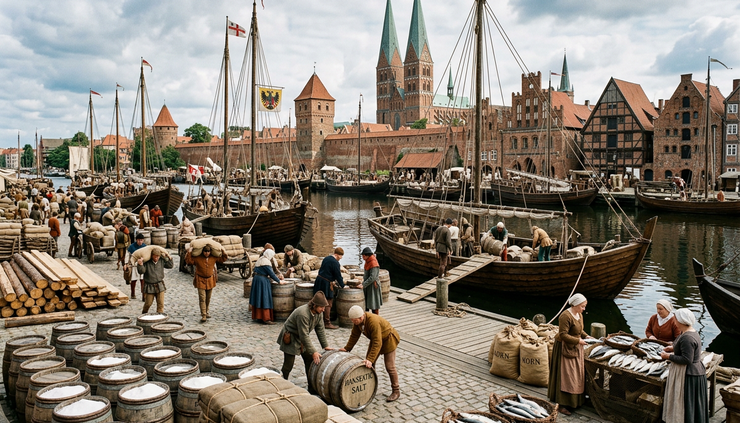
In the late Middle Ages, Lübeck was one of the great trading centres of northern Europe. Its harbour connected the Baltic Sea with markets in Flanders, London, Scandinavia, the Baltic region, and Novgorod in present-day Russia. Ships carried grain, cloth, fish, furs, wax, salt, wood, and other goods that tied distant regions together.
Lübeck’s importance rested on the Hanseatic League, a loose network of merchant cities. It was not a country, and it did not have a modern economic ministry. It worked because merchants shared interests, routes, privileges, warehouses, legal habits, and commercial trust.
This matters because Germany’s export story starts before Germany itself. The Holy Roman Empire was politically fragmented. Towns, principalities, church territories, free cities, and regional rulers all shaped trade in different ways. That fragmentation created barriers, but it also produced many local centres of skill.
Some cities became known for trade. Others for textiles, metalwork, printing, mining, or finance. Over time, these places learned to serve customers outside their own walls.
A few patterns became important:
Ports linked inland producers to distant markets
Lübeck, Hamburg, Bremen, and other northern cities connected regional goods to European trade routes.
Market towns built commercial habits
Fairs in places such as Frankfurt and Leipzig brought merchants, booksellers, cloth traders, and financiers together.
Craft regions developed reputations
Areas with strong guilds and skilled workshops built trust through quality and reliability.
Germany’s later export economy did not replace these older habits. It built on them. The Hanseatic merchant and the Swabian machine builder were centuries apart, but both depended on the same basic idea: make or source something useful, then sell it beyond the local market.
Fragmentation forced regions to specialise
Political division slowed the creation of one national market. For centuries, moving goods across German-speaking lands could mean passing through many borders, toll stations, currencies, and legal systems. That made trade harder and more expensive.
Yet fragmentation had an unexpected effect. Regions often had to develop their own strengths.
Saxony became associated with textiles, mining, and later mechanical engineering. The Rhineland and Ruhr grew around coal, iron, and heavy industry. Baden and Württemberg fostered skilled metalworking and machine production. Cities such as Nuremberg and Augsburg had long traditions in craft, trade, and precision work. Hamburg and Bremen looked outward through sea trade.
This regional variety became one of Germany’s great advantages. Instead of one dominant economic centre, the country grew many specialised clusters. These clusters linked workshops, suppliers, training institutions, banks, and local customers.
By the 19th century, one problem became impossible to ignore. Internal barriers limited growth. A manufacturer who wanted to sell across German territories needed simpler rules and easier transport.
The Zollverein, the customs union formed in the 19th century under Prussian leadership, helped solve part of this problem. It reduced internal customs barriers among many German states and made trade across a larger domestic market easier. Producers could scale up. Railways could connect industrial regions. Suppliers could reach factories more efficiently.
The customs union did not create German export strength by itself. It gave businesses a larger home base from which to grow.
That home base mattered. Firms that could compete across German regions gained experience before competing abroad. They learned to standardise parts, manage distribution, improve quality, and respond to customers beyond their immediate area. A larger domestic market became a training ground for international trade.
Industrialisation turned skill into scale
Germany industrialised later than Britain, but it caught up fast in several key fields. Its rise came from coal and steel, but also from education, science, and technical training.
The Ruhr became a centre of coal mining, iron, and steel. Railways created huge demand for rails, locomotives, bridges, tools, and machinery. Chemical production grew from laboratory knowledge and industrial application. Electrical engineering opened new markets in power generation, lighting, motors, and communications.
By the late 19th century, Germany had become especially strong in industries where technical knowledge and production discipline mattered.
This was not just about having factories. Many countries had factories. Germany’s edge came from linking production with research, training, and applied science.
Several institutions helped:
Technical universities trained engineers.
Vocational education connected young workers to skilled trades.
Research laboratories turned chemistry and physics into commercial products.
Banks often supported industrial expansion over longer time horizons.
Local supplier networks helped firms improve parts, tools, and machines.
The chemical industry is a clear example. German companies became known for dyes, pharmaceuticals, fertilisers, and industrial chemicals. These fields required scientific knowledge, careful processes, and constant improvement. They also served global demand.
Machine building followed a similar path. German firms produced equipment that other industries needed: printing machines, textile machines, mining equipment, engines, pumps, and later vehicles and electrical systems. Selling machines abroad created a powerful feedback loop. Customers in different countries had different needs, which pushed firms to adapt and improve.

Industrialisation also changed the meaning of exports. The older trade in grain, salt, furs, and cloth did not disappear, but manufactured goods became more important. Germany increasingly sold products that carried a high level of skill inside them.
That became a lasting feature of the German model. The country did not compete only by having cheap raw materials. It competed by turning knowledge into reliable goods.
German makers built trust through quality and adaptation
By the end of the 19th century, German goods had a mixed reputation in some foreign markets. British industry, in particular, had dominated many manufactured exports. German producers had to prove that they could match or beat established suppliers.
They did so by improving product quality, technical support, and reliability. Over time, the label “Made in Germany”, first introduced in Britain as a mark of origin, became associated in many markets with careful engineering and dependable products.
That change did not happen because of a slogan. It happened because buyers had reasons to return.
German export firms often succeeded in sectors where customers valued:
durable machinery
precise tools
technical service
spare parts
customisation
steady product improvement
A farmer buying equipment, a factory buying a machine tool, or a railway operator buying electrical systems made decisions differently from a shopper buying a simple consumer item. These customers cared about performance over time. They needed repairs, documentation, and trust.
German firms learned to compete in these demanding markets.
The rise of the Mittelstand became central to this pattern. The term refers to small and medium-sized companies, often family-owned, often based outside the biggest cities, and often highly specialised. Many sell to other businesses rather than directly to consumers. Some dominate narrow global niches, such as machine components, industrial sensors, packaging equipment, or specialised tools.
The Mittelstand works well for exports because these firms often know their product category in great detail. They do not need to be famous to ordinary consumers. They need to be trusted by buyers who understand the value of expertise.
This also explains why Germany’s export power is spread across the country. It is not only the story of car plants or large chemical groups. It is also the story of towns where a company spends decades improving one type of valve, cutting machine, measuring device, or production system.
World markets rewarded specialised industry
The 20th century brought war, destruction, division, and reconstruction. Germany’s export economy did not move in a straight line. The First World War, the Great Depression, the Nazi regime, the Second World War, and the division into West and East Germany reshaped the country in brutal ways.
After 1945, West Germany rebuilt its economy with strong industrial foundations, a skilled labour force, currency reform, the social market economy, and access to Western markets. Exports became a key part of recovery. Firms that had lost domestic assets or faced a divided home market looked outward. European integration also helped reduce trade barriers and created more stable markets for industrial goods.
The post-war export boom often gets linked to cars, and for good reason. Volkswagen, Mercedes-Benz, BMW, and later other brands became globally recognised. Yet the deeper story is broader. German companies exported machinery, chemicals, electrical equipment, medical devices, industrial components, and production systems.
East Germany also had industrial capacity, but its economy operated under different political and trade conditions within the socialist bloc. After reunification in 1990, the adjustment was difficult, and many eastern industries collapsed or had to be rebuilt. Over time, parts of eastern Germany developed new strengths in manufacturing, optics, logistics, and technology-related fields.
Germany’s place in the European Union and the euro area later strengthened its export position. Open borders, common rules, close supply chains, and a shared currency with many European partners made cross-border trade easier. Central and Eastern Europe became important production and supplier regions for German industry.
At the same time, globalisation opened markets far beyond Europe. German firms sold factory equipment to Asia, vehicles to North America and China, chemicals to global industries, and precision tools wherever advanced production grew.
This success created strengths and risks. An economy with large export sectors benefits when global demand is strong. It can suffer when supply chains break, energy prices rise, geopolitical tensions grow, or major customers slow down. Germany’s recent debates about energy, China, electric vehicles, and industrial policy all reflect the same fact: export strength brings exposure to the world.
The export model still rests on old foundations
The question “How did Germany become an exporting nation?” has no single answer. It was not one law, one company, or one invention.
It began with merchants who built routes across the Baltic and North Sea. It grew through regional specialisation in towns and territories long before national unity. It accelerated when customs barriers fell, railways spread, and factories connected skill with scale. It matured through science-based industries, technical education, and firms that learned to sell complex products to demanding customers.
The result was an economy built around more than volume. Germany became an export power because it became good at producing goods that other economies needed to build, move, measure, power, and improve things.
That is why the history still matters. The same forces that shaped German trade in the past still shape its choices now:
keep technical skills strong
support regional industrial clusters
invest in research and training
adapt to new markets without losing quality
build products that solve real problems for buyers
Germany’s export success was created over centuries, from Hanseatic quays to machine halls and world markets. Its future will depend on whether it can renew that old formula for a changed world.


Comments